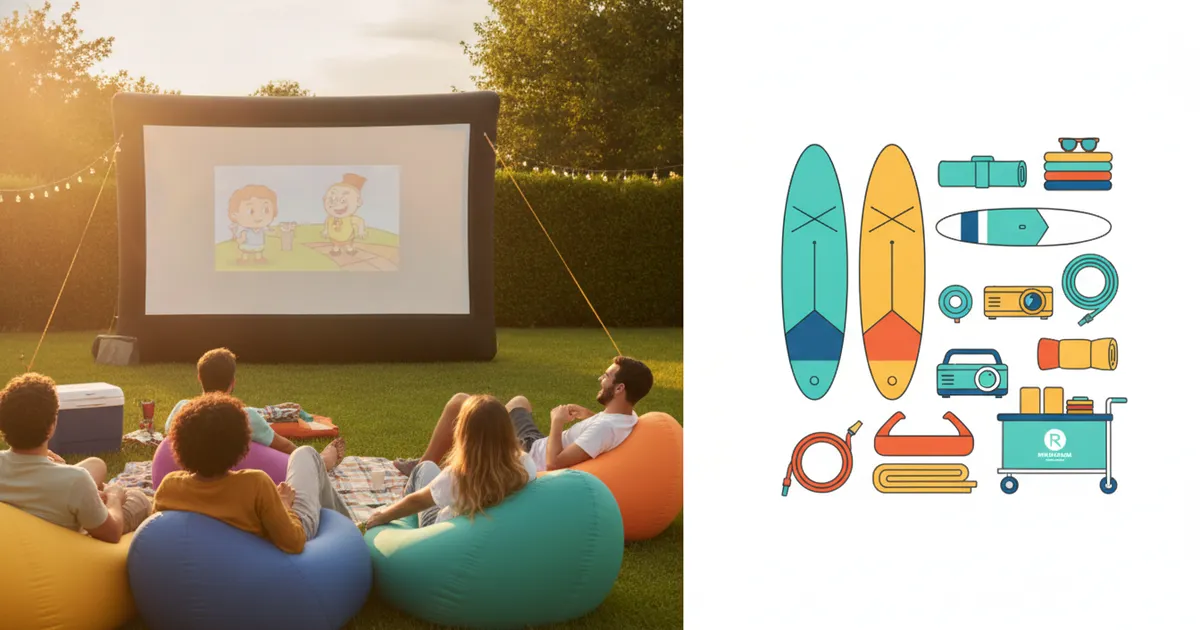
The best summer 2026 side hustles are not the ones most people are talking about. While everyone else is signing up for delivery apps and picking up freelance gigs, a small group of people are asking a completely different question: who is supplying all of this? Every backyard movie night, every HOA block party, every family paddling out on a lake — someone owns that equipment and is getting paid for it. This post is about becoming that person. If you are already exploring passive income ideas as a path away from the 9-5, asset-based seasonal rentals deserve a serious look. We are going to cover two specific, asset-based seasonal rental models — renting outdoor movie screens and summer gear — in full detail: what they cost to start, how to price them, where to list, how to manage the operation, and how to combine both for maximum return in a single summer season.
Key Takeaways
- Asset-based rental side hustles let you earn while your equipment does the work — one screen setup can serve an event without your constant presence, unlike service-based work that trades your hours for money.
- The global peer-to-peer rental market is projected to grow from over $19 billion in 2025 to more than $61 billion by 2036 — the structural tailwind behind these models is real and growing.
- Outdoor movie screen rentals can generate profit margins of 60% to 80% after operational costs once equipment is paid down, with basic packages typically priced between $300 and $600 per event.
- Summer gear rentals — kayaks, paddleboards, camping equipment, lawn games — serve a customer who does not want to own bulky, expensive gear they use a handful of times per year.
- Stacking both hustles under one operation dramatically increases revenue per client, because the same customer who books a movie screen is an ideal buyer for lawn chairs, coolers, and outdoor games.
- Insurance is not optional: standard homeowner's or business policies do not cover commercial rental activity. The wrong policy is not a calculated risk — it is an uncapped liability.
Table of Contents
- Why Summer 2026 Is a Legitimate Window to Act
- What Makes a Good Summer 2026 Side Hustle
- Side Hustle #1 — Renting Outdoor Movie Screens
- Side Hustle #2 — Renting Summer Gear
- How to Stack Both Hustles for Maximum Return
- How to Get Started Before Summer 2026
- Honest Risks to Know Before You Start
- FAQ
Why Summer 2026 Is a Legitimate Window for Rental Side Hustles
This is not generic "now is a great time to start a business" framing. There are specific, measurable conditions making summer 2026 a smart window to enter the seasonal rental market. Here is what the data actually shows.
The Experience Economy Is Driving Demand for Rental Equipment
In 2026, consumers are increasingly seeking what researchers describe as "visceral, high-fidelity encounters" — real-world, in-person experiences — and are actively willing to spend less on technology and physical goods to fund them. Backyard movie nights, lake days, camping weekends, block parties — these are not fringe activities. They are the exact category of experience consumers are prioritising with their discretionary spending.
This is a direct tailwind for anyone supplying the equipment that makes those experiences possible.
The Peer-to-Peer Rental Market Is on a Decade-Long Growth Curve
The global peer-to-peer rental market is projected to grow from over $19 billion in 2025 to more than $61 billion by 2036, at a compound annual growth rate of 10.9%. The core driver is a structural consumer shift away from ownership and toward access — especially for seasonal or infrequently used items. People do not want to store a 16-foot inflatable screen in their garage. They want to rent one for a Friday night and send it back.
The Event Rental Industry Is Growing in the Right Direction
The U.S. event rental industry is forecasted to see 8% revenue growth in 2026, reaching $6.1 billion. The broader party supply rental market is expected to hit $8.5 billion that same year. These are not optimistic projections from a niche trade journal — these are mainstream market numbers that signal genuine commercial opportunity for small operators entering the space.
Outdoor Recreation Has Outpaced the Broader Economy for Over a Decade
The outdoor recreation sector has been expanding faster than the broader U.S. economy for over a decade. This is not a post-pandemic blip. It is a sustained consumer reorientation toward outdoor activities — which means sustained demand for the gear that enables them.
The Seasonal Concentration Advantage
Summer creates a natural demand spike. Memorial Day through Labor Day represents roughly 14 weeks of peak earning potential in most U.S. markets. Competition is lower than in year-round markets. A small number of strong weekends — booked at the right price — can generate meaningful side income in a concentrated window. That predictability is a planning advantage, not a limitation.
What Makes a Good Summer 2026 Side Hustle Worth Pursuing
Most side hustle content lumps everything together. Driving for Uber, selling on Etsy, doing odd jobs — all treated as equivalent. They are not. The best side hustles in 2026 share specific characteristics that separate them from glorified part-time jobs.
- Low barrier to entry. No licence, no degree, no years of experience required. Capital (which can be staged), organisation, and follow-through are enough to get started.
- Asset-based, not time-based. Service businesses scale with hours. Rental businesses scale with inventory. One person running two outdoor movie screen setups can serve two simultaneous events. A freelancer cannot be in two places at once.
- Seasonal demand spikes. A side hustle that earns most of its annual revenue in 10 to 12 concentrated summer weekends is not a flaw — it is a feature. It means you can plan around predictable high-demand windows and price accordingly.
- Clear monetisation path. The best seasonal hustles have transparent pricing, known platforms for distribution, and an identifiable customer. No guesswork about where demand comes from.
- Scalability from year one to year two. The model should be able to grow with reinvestment — more inventory, more listings, more bookings — without requiring the operator to trade proportionally more time.
The core distinction this post is built around: trading hours versus deploying assets. When you deploy an asset, you set it up, hand it over, and it earns. When you trade hours, every dollar requires your physical presence. The two models below meet all five criteria. Here is each one in full detail.
Side Hustle #1 — Renting Outdoor Movie Screens
What This Business Actually Looks Like
An outdoor movie screen rental business means owning a portable cinema setup — inflatable screen, projector, sound system — and renting the complete package out to customers for private or community events. The operator delivers, sets up, and either stays on-site as a technician or leaves the equipment with the renter depending on the package tier.
Use cases include:
- Backyard birthday parties and celebrations
- HOA and neighbourhood community movie nights
- Date nights and anniversary events
- Corporate team-building events and brand activations
- School and PTA fundraiser events
- Neighbourhood block parties
This is not a niche market. It is a cross-demographic product that serves families, community organisations, and businesses — all from the same equipment setup.
Equipment Breakdown
A standard outdoor cinema rental package includes:
- A large inflatable screen — 12 to 20 feet is the common range for backyard and community events. Larger commercial screens are used for public or brand-activation events.
- A high-lumen projector — lumens matter because outdoor setups compete with ambient light at dusk. A higher lumen count produces a better image in real-world conditions.
- A professional PA speaker system — consumer-grade Bluetooth speakers are not adequate for this application.
- A media player — laptop, Blu-ray player, or streaming device to run the film content.
The operator is responsible for delivery, inflation, setup, and breakdown after the event. Invest in commercial-grade equipment from the start. Consumer-grade items fail faster under repeated rental use, create safety risks, and generate the kind of negative reviews that kill a young rental business.
Startup Costs for Outdoor Movie Screen Rentals
A basic professional outdoor movie setup — including a quality projector, an inflatable screen, and a sound system — costs between $5,000 and $20,000. A smaller, entry-level kit can be assembled for $2,000 to $7,000, which is a reasonable way to test the market before committing to a full commercial rig.
A sound strategic approach is to start with one setup, price it correctly, and reinvest first-season revenue into a second kit. Running two simultaneous events doubles your earning ceiling without adding a proportional increase in marketing or overhead cost.
Pricing and Package Structure
Pricing is structured by screen size and event duration. A basic backyard package for up to 75 guests typically starts around $449 and includes a 12-foot screen with an on-site technician. Basic packages broadly range from $300 to $600. Larger screens for public or commercial events command $850 to over $1,500.
Structure your offering in two to three tiers from day one:
- Basic package — smaller screen, standard projector, drop-off and setup included
- Standard package — larger screen, high-lumen projector, PA speakers, on-site technician
- Premium/event package — largest screen, full AV setup, on-site technician, add-ons available (popcorn machine, seating, outdoor lighting)
| Package Tier | Screen Size | Includes | Typical Price Range | Best For |
|---|---|---|---|---|
| Basic | 12 ft inflatable | Projector, screen, basic audio, setup | $300 – $449 | Small backyard parties, up to ~50 guests |
| Standard | 14–16 ft inflatable | High-lumen projector, PA speakers, media player, technician | $449 – $850 | HOA events, birthday parties, up to ~75–100 guests |
| Premium / Event | 18–20 ft inflatable | Full AV rig, technician, add-ons available | $850 – $1,500+ | Corporate events, brand activations, large community nights |
Earning Potential — What Is Realistic
Profit margins on this business can range from 60% to 80% after operational costs once the equipment investment is covered — because the main ongoing costs are fuel, maintenance, and labour if you hire help. Full-time operators running multiple setups can potentially see annual revenues between $30,000 and $120,000 before expenses. That range represents a full-time, multi-setup operation, not a first-year guarantee on a single kit. A part-time operator running one setup on summer weekends occupies the lower end of that range — still a meaningful, real side income from a single asset.
Where to Market and List Your Outdoor Cinema Service
- Local SEO — Optimise a Google Business Profile and any website for terms like "outdoor movie rental near me." This is where high-intent buyers search when they are ready to book.
- Facebook Marketplace — Strong for local, event-based services. Free to list and reaches a large local audience actively searching for party and event suppliers.
- Local community Facebook groups — Post directly in neighbourhood groups, HOA groups, and local parenting and events groups. These audiences are exactly your target customer.
- Instagram — A visual platform well suited to this product. Short video clips of a setup in action perform well, build social proof, and attract organic reach.
- Nextdoor — Hyperlocal platform ideal for reaching HOAs and neighbourhood event organisers who are actively planning community activities.
- Direct outreach — Contact HOAs, school PTAs, corporate event coordinators, and local businesses directly with a simple service menu. One well-placed email or phone call to the right HOA manager can generate recurring seasonal bookings.
Logistics to Plan For Before Your First Booking
- Delivery vehicle. A truck, van, or trailer is essential. Inflatable screens and AV gear require significant cargo space. Factor this into startup costs if you do not already own a suitable vehicle.
- Setup time. Plan for one to two hours of setup and 45 to 60 minutes of breakdown per event. Build this labour time into your pricing so you are not working for free.
- Damage deposits. Collect a deposit — typically 20 to 30% of the booking value — at the time of booking. Include clear terms of service covering damage, cancellation, and late returns.
- Insurance. General liability insurance is non-negotiable. The industry standard is a $1,000,000 policy. Standard homeowner's or renter's insurance does not cover commercial rental activity. This must be a separate, specific business policy purchased before any equipment leaves your possession.
- Booking system. Use a simple tool — HoneyBook, Dubsado, or even a Google Form connected to a payment link via Stripe or PayPal — to manage bookings without overbooking. Tools like Calendly can handle scheduling and availability management cleanly in the early stages, and Tally works well for custom intake forms that capture event details before you confirm a booking.
Keeping the Operation Moving Between Bookings
- Document every setup with photos and short video for social content and future social proof.
- Ask for a Google or Facebook review after every single event. Reviews compound over time and reduce future marketing costs significantly.
- Offer a referral discount to customers post-event. Event hosts know other event hosts.
- Test add-on offerings — popcorn machines, lawn chairs, outdoor string lights — to increase revenue per booking without adding a new hustle entirely.
Side Hustle #2 — Renting Summer Gear
What Counts as Rentable Summer Gear
Summer gear rental means building a small inventory of seasonal outdoor equipment and renting individual items or bundles to individuals, families, and groups who need temporary access to things they do not want to own.
High-demand, profitable inventory categories include:
- Kayaks and stand-up paddleboards (SUPs) — among the highest-demand water sport rental items. Sit-on-top kayaks are recommended for rental fleets because of their stability and ease of use for beginners — the typical rental customer.
- Camping gear — tents, sleeping bags, camping chairs, lanterns. Popular with casual campers who want a single trip experience without owning a full kit.
- Lawn games — cornhole, bocce, giant Jenga, croquet sets. High demand for backyard parties and outdoor events, low storage burden, and low cost to acquire.
- Premium coolers — Yeti-style hard coolers are expensive to own but popular to rent for trips and events. High perceived value for the renter at a low cost per rental to the operator.
- Beach and outdoor shade structures — pop-up tents, beach umbrellas, gazebos for outdoor parties and beach days.
- Bicycles — urban and recreational bikes for tourists and short-term visitors. Spinlister is a specialist platform for this category.
- Outdoor accessories — string lights, outdoor speakers, folding furniture. Natural add-ons to either gear rentals or movie screen bookings.
Why People Rent Instead of Buy
Understanding this psychology is key to marketing your gear rental business effectively. People rent seasonal equipment for four consistent reasons:
- Cost. A high-quality kayak, paddleboard, or quality camping tent represents significant upfront spend for an item used a handful of times per year.
- Storage. Most suburban and urban households have no space for bulky outdoor gear.
- Access to better quality. Renters often get access to commercial-grade, well-maintained equipment that is better than anything they would buy for themselves.
- Convenience for travellers. Tourists cannot bring bulky gear. They need local access to the equipment that makes their trip possible.
This psychology is not changing. The peer-to-peer rental market's 10.9% CAGR reflects a structural consumer preference for access over ownership — this is a long-term market shift, not a trend that reverses when the season ends.
Startup Costs for Summer Gear Rentals
Launching a small kayak rental fleet of 10 to 15 boats with paddles and personal flotation devices (PFDs) costs between $7,000 and $20,000. General liability insurance for a kayak rental business ranges from $1,000 to $3,000 annually — and critically, this policy must explicitly cover watercraft rentals, which is a different product from standard business liability insurance.
Lower-cost entry points exist. A starter collection of lawn games, premium coolers, and camping accessories can be assembled for a few hundred to a few thousand dollars — a viable way to test local demand before committing to a full water-sports fleet.
Pricing Strategy for Gear Rentals
The most effective approach is a tiered pricing model: hourly, half-day, full-day, and weekly rates. Longer rentals are more profitable per unit of logistics effort — fewer pickups and drop-offs, more revenue per transaction. Tandem kayaks command approximately 30% higher rates than single kayaks.
Bundle pricing increases revenue per transaction without increasing your customer acquisition cost. A "beach day package" combining chairs, umbrella, cooler, and towels at a flat rate is easier to say yes to than pricing each item separately.
| Item | Hourly Rate | Half-Day Rate | Full-Day Rate | Notes |
|---|---|---|---|---|
| Single Kayak | $25–$40 | ~$50–$70 | $75–$120 | Sit-on-top recommended for rental fleets |
| Tandem Kayak | $35–$55 | ~$70–$95 | $100–$155 | ~30% premium over single kayak rate |
| Stand-Up Paddleboard | $25–$40 | ~$50–$70 | $75–$120 | High demand near water access points |
| Camping Tent (2–4 person) | N/A | N/A | $25–$50 | Weekend rate often 1.5x the daily rate |
| Beach Day Bundle (chairs, umbrella, cooler) | N/A | N/A | $40–$80 | Bundle pricing encourages single larger transaction |
| Lawn Game Set | N/A | N/A | $30–$60 | Popular for backyard parties and outdoor events |
Platforms to List Summer Gear
- Fat Llama — peer-to-peer rental marketplace for a wide variety of gear categories; built-in buyer protections and an existing audience of active renters.
- Spinlister — specialist platform for bikes, surfboards, and snowboards; strong for niche sporting equipment and recreational gear.
- Facebook Marketplace — broad local audience, free to list, works well for high-demand items like kayaks, paddleboards, and camping gear.
- Personal website with booking integration — even a simple Squarespace or Wix site with a booking and payment tool makes the operation look professional and enables direct bookings that bypass platform fees entirely. Zapier can connect your booking forms, payment tools, and calendar so the whole system runs with minimal manual effort.
- Outdoorsy, Campspot, and KSL Classifieds — niche platforms worth evaluating based on your gear category and geographic market.
Being listed across multiple platforms increases visibility and booking frequency. Manage availability carefully across all channels to prevent double-bookings — this is where a centralised calendar and booking system pays for itself.
Managing Risk in a Gear Rental Operation
Standard business or homeowner's insurance policies typically do not cover equipment rentals, especially for watersports. For kayaks and paddleboards specifically, the policy must explicitly cover watercraft rentals — this is a distinct insurance product. For outdoor movie screen rentals, a $1,000,000 general liability policy is the industry standard. Get the right coverage before any equipment leaves your possession.
Beyond insurance:
- Collect a refundable damage deposit at booking and document equipment condition with timestamped photos before handoff and at return.
- Inspect every item before and after every rental. Commercial-grade gear lasts longer but still requires routine maintenance — factor this into your annual operating costs.
- Use a written rental agreement that covers liability, damage, late returns, and cancellations. Legal document platforms like LegalZoom or Rocket Lawyer offer templates that can be adapted quickly.
How Reviews and Word of Mouth Build the Business
Early reviews are the most valuable asset in the first season. A five-review track record on a platform like Fat Llama or Facebook Marketplace converts new customers more effectively than any paid advertisement, because it removes the core objection: can I trust this person with my plans for the weekend?
Ask every single renter to leave a review on the platform they booked through. Do not assume they will do it without being asked — most people need a direct, friendly prompt. Happy customers also refer friends, and in the outdoor recreation and event space, social groups tend to want the same gear around the same time.
How to Stack Both Hustles for Maximum Return
The core insight that makes this combination so effective: both hustles serve the same customer. The outdoor event host. The active family. The HOA social committee chair. A family booking an outdoor movie screen for Saturday night is an ideal candidate to also rent lawn chairs, a premium cooler, outdoor string lights, and a lawn game set from the same operator.
Cross-Selling in Practice
When confirming a movie screen booking, include a short add-on menu as part of the confirmation message or booking form. The customer does not have to source these items separately — you are saving them time and logistics effort. Convenience is the sell, not a hard upsell.
A concrete stacking example:
- Customer books: 16-foot outdoor movie screen package — $600
- Adds: 20 lawn chairs — $80
- Adds: premium cooler — $30
- Adds: lawn game set — $40
- Adds: outdoor string lights — $30
- Total booking value: $780 vs. $600 for the screen alone — a 30% revenue increase with zero additional customer acquisition cost
One Operation, Multiple Revenue Lines
The same vehicle. The same delivery window. The same customer relationship. Used to sell more.
Over time, operating both models positions the business as a full outdoor event equipment supplier — a more defensible and premium category than either hustle operated alone. Customers start to think of you as their go-to source for outdoor gatherings, not just "the movie screen people."
Shared Infrastructure Keeps Fixed Costs Low
Both hustles share the same core operational requirements: a vehicle for transport, a booking and payment system, liability insurance, and a local marketing presence. The fixed costs are largely the same whether you run one model or both. This means the marginal cost of adding the second hustle is lower than starting it independently — and the incremental revenue goes almost directly to the bottom line. If you are already using a tool like Zapier to automate booking confirmations and calendar entries for movie screen rentals, the same automation applies to gear bookings at no extra setup cost.
How to Get Started Before Summer 2026
Timeline — When to Move
The window before peak season is where most operators lose time they cannot buy back. Starting equipment research and acquisition in fall and winter of 2025 means you are not making rushed purchasing decisions under summer pressure.
- Fall/Winter 2025: Research and acquire primary equipment. Compare suppliers, test gear quality, negotiate pricing. This is the window to make unhurried decisions.
- January–February 2026: Set up business infrastructure — register a business name, open a dedicated business bank account, purchase insurance, build a simple website or booking page.
- February–March 2026: Begin creating social content. Document your setup, film short demos, start building a local audience before demand peaks. Early posts establish credibility before you need it.
- March–April 2026: Go live on listing platforms. Reach out to HOAs, event coordinators, and community groups. Offer a discounted launch rate on the first few bookings in exchange for honest reviews.
- May 2026 (pre-Memorial Day): Be fully operational with at least a handful of positive reviews in place before peak season demand hits. Do not enter summer without social proof.
Minimum Viable Starting Point for Each Hustle
Outdoor Movie Screens:
- Minimum: one entry-level setup ($2,000–$7,000) — one screen size, one projector, one speaker set.
- Start with backyard party packages only. Add commercial event capacity as revenue allows and the operation is proven.
Summer Gear Rentals:
- Minimum: two to four high-demand items — for example, two single kayaks plus two SUPs if you are near water, or a curated lawn game collection for a suburban or landlocked market.
- Match your initial inventory to your specific geography. Coastal and lake markets: lead with water gear. Suburban and landlocked markets: lead with lawn games, camping gear, and coolers.
Setting Up a Simple Booking and Payment System
A booking system does not need to be complex in year one. The minimum requirement is simple: customers can see availability, submit a booking request, pay a deposit, and receive a confirmation — all without requiring the operator to manually manage every exchange.
Options that work well at this scale include HoneyBook (built for event and service businesses), Calendly connected to a Stripe payment link (free to start and clean for the customer), or a Squarespace or Wix site with built-in booking tools. Tally works well for building detailed intake forms that capture all the event information you need before confirming. Efficient systems prevent overbooking and eliminate the back-and-forth communication that eats hours during peak season.
Building Social Proof Before Peak Season
The first three to five bookings are the hardest — no reviews, no track record. The strategy to move past this is straightforward: offer a soft-launch discount in April and May 2026 — not a permanent price reduction, but a time-limited introductory rate — in exchange for a detailed, honest review.
Document every early job with photos and short video. Repurpose it as organic social content. Ask early customers to tag your business on social media — user-generated content is more credible than anything you create yourself.
What Success Looks Like — Year One vs. Year Two
Year One goals:
- Recoup a meaningful portion of your equipment investment
- Build a review base — target 10 or more verified, positive reviews across platforms
- Identify which items and packages generate the most bookings and the best margins
- Learn the operational rhythms — timing, transport, customer communication patterns
Year Two goals:
- Expand inventory into your highest-performing categories
- Add a second movie screen setup to enable simultaneous events
- Begin generating repeat and referral bookings without heavy marketing spend
- Evaluate whether the operation can transition from side hustle to primary income source
For operators serious about growing this into a full business, platforms like Foundr+ and Shopify Learn offer structured courses on scaling a product-based or rental business — useful once you are past the initial setup phase and thinking about systems, team, and growth.
Honest Risks to Know Before You Start These Summer Side Hustles
There is no version of this where the risks do not exist. Here is what they are, stated plainly.
- Seasonality is real. These are warm-weather businesses. Revenue concentrates in summer months. Budget and plan for lower income in fall and winter. Do not spend summer income as if it is available year-round.
- Insurance gaps can be catastrophic. Operating without the right, specific liability coverage — especially for watersports — is not a calculated risk. It is an uncapped financial exposure that can wipe out multiple seasons of profit in a single incident. Get the right policy before the first rental goes out the door.
- Equipment quality matters more than you think. Consumer-grade gear fails faster, creates safety risks, and generates the kind of negative reviews that are nearly impossible to recover from in a local market. Commercial-grade equipment is the correct investment for a rental business, not a nice-to-have.
- Logistics require a vehicle. Neither hustle functions without a reliable van, truck, or trailer. If you do not have one, factor vehicle cost or rental cost into your true startup number — and your operating cost per booking.
- Overbooking is a reputation killer. In year one, it is better to be conservative with booking volume than to double-book and fail a customer. A single broken promise erases the review you were counting on. Use a booking system that shows live availability — whether that is Calendly, HoneyBook, or anything that syncs across your listings.
FAQ
How much does it cost to start an outdoor movie screen rental business?
A basic professional setup — quality projector, inflatable screen, and sound system — typically costs between $5,000 and $20,000. A smaller, entry-level kit can be assembled for $2,000 to $7,000. Starting at the lower end and reinvesting first-season revenue is a sound approach before committing to a larger commercial rig.
What kind of insurance do I need for a rental side hustle?
For outdoor movie screen rentals, general liability insurance is the minimum requirement, with a $1,000,000 policy being the industry standard. For watersports gear — kayaks, paddleboards — you need specialised liability insurance that explicitly covers watercraft rentals. Standard homeowner's, renter's, or general business policies do not cover commercial rental activity. Do not assume existing coverage is sufficient. Verify with your insurer before the first rental goes out.
What summer gear items are the most profitable to rent out?
Kayaks and stand-up paddleboards consistently lead demand in markets with water access. Lawn game sets (cornhole, giant Jenga, bocce) offer strong demand in suburban markets with low initial investment. Premium coolers have high perceived value for renters relative to the operator's cost. Camping gear — tents, sleeping bags, chairs — performs well in areas near campgrounds and with casual first-time campers who do not want to invest in full kits.
Do I need a website to run a summer gear or movie screen rental business?
A website is not mandatory in year one, but it is strongly recommended. Even a simple one-page site with a booking form, pricing menu, photos, and a contact method makes the business look credible and enables direct bookings that avoid platform fees. Squarespace and Wix both offer beginner-friendly options. A direct booking via your own site is more profitable than one through a marketplace that takes a commission.
How do I get my first few bookings when I have no reviews?
Offer a time-limited soft-launch discount in exchange for an honest review. Reach out directly to local HOAs, school PTAs, neighbourhood Facebook groups, and community event organisers. Post on Nextdoor. The first few bookings require active outreach — the reviews those bookings generate make every subsequent booking easier to convert. Do not wait passively for inbound interest in the first season.
Can I run outdoor movie screen rentals and summer gear rentals simultaneously as one business?
Yes, and it is the recommended approach. Both models share the same core operational infrastructure — a vehicle, a booking system, liability insurance, and local marketing. The same customer who books a movie screen is often willing to add lawn chairs, a cooler, outdoor games, and lighting to the same order. Stacking both models increases revenue per client without proportionally increasing overhead or customer acquisition costs. If you are looking at passive income streams that actually work, this combined model — where assets earn across multiple bookings simultaneously — fits that framework well.
Is the summer rental market too competitive to enter in 2026?
Recommended tools & courses
- Calendly — Lets prospects book calls straight off your link — no back-and-forth — so fewer sales and coaching calls fall through the cracks.
- Tally — Free form builder with unlimited forms and submissions — client intake, waitlists and lead magnets without a response cap eating your funnel.
- Zapier — Automates repetitive tasks between your apps — new sale, new lead, new post — so you spend more time on paid work, not busywork.
- Shopify Learn — Shopify's free official education hub — store setup, product sourcing, marketing and operations, taught directly by the platform maker.
- Foundr+ — Membership giving access to 30+ business courses on ecommerce, Instagram growth, copywriting and more, taught by working founders.
Some links above are affiliate links — we may earn a commission at no extra cost to you.