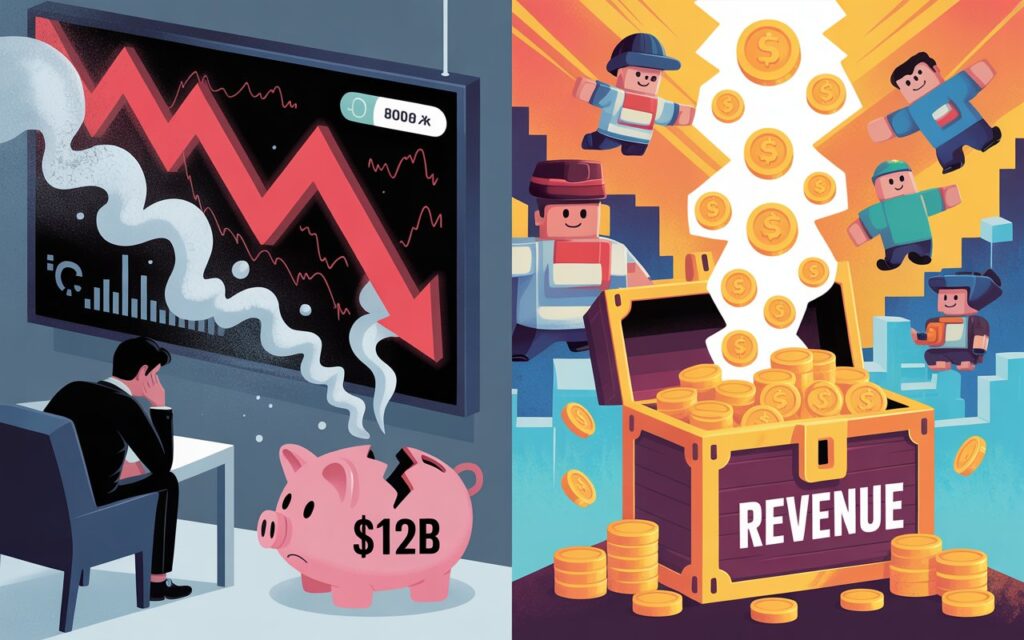
The Roblox Loses 12 Billion: What Does It Mean and How Does It Connect to 12 Billion?
Estimated reading time: 8 minutes
Key Takeaways
- The widely reported “12 billion loss” refers to market cap fluctuation, not cash missing from Roblox’s balance sheet.
- Roblox does show consistent financial losses in the hundreds of millions each quarter.
- Investor confidence has dropped due to lawsuits, safety concerns, and revenue challenges.
- Despite the news, Roblox remains a multi-billion dollar force in gaming with a large user base.
- Understanding the nuances of market cap vs. actual spending is essential for interpreting financial headlines.
Table of Contents
- The Roblox Loses 12 Billion – A Dive into Market Cap, Cash, and Company Resilience
- What is a Market Cap Drop, and What Does It Tell Us?
- Is Roblox Losing Money? The True Financials
- But Why Are Investors Pulling Their Support?
- Is a 12 Billion Loss the Start of the End? Not Likely
- Putting It All Together: Has Roblox Company Actually Lost 12 Billion Dollars?
- Frequently Asked Questions
The Roblox Loses 12 Billion – A Dive into Market Cap, Cash, and Company Resilience
The news of Roblox shedding 12 billion dollars in value sent shockwaves across the tech realm. Yet many wonder: Is Roblox losing real money, or is this “loss” essentially tied to stock market perception? It’s all about market capitalization
(often shortened to market cap)—which is akin to a “Total Market Value Estimate” of all company shares. The bottom line:
this is not the same as losing 12 billion dollars in an actual vault.
Such drops, though, reflect deeper corporate challenges—think investor confidence, legal hurdles, strategic direction, and
potential hits to future revenue. “Loss” can sound devastating, but it often depicts how investors react to external news more than it discloses a company draining its own funds.
What is a Market Cap Drop, and What Does It Tell Us?
When the financial headlines shout “12 billion dollars lost,” casual observers might assume Roblox is hemorrhaging real cash. But market cap changes essentially track the share price on the stock market:
- Shifting share prices sometimes mirror collective investor sentiment and economic contexts.
- These fluctuations don’t necessarily equal an empty bank account; rather, they’re about perceived future
potential. - A 12 billion drop doesn’t mean the company wrote a $12 billion check to cover operational losses.
This point can’t be overstated: the market can swing back should sentiment improve.
Is Roblox Losing Money? The True Financials
It’s true that Roblox does operate at a loss. So yes, they spend more than they bring in to prioritize growth. In the last quarter, for example, they reported a net loss around $280 million, yet still saw a 21% year-over-year gain in user counts and generated
nearly $1.1 billion in revenue.³ They’ve also noted annual losses in the realm of $200–325 million per quarter. Four quarters like that can add up to nearly $1 billion a year.
However, don’t confuse this with the widely publicized $12 billion figure—there are no credible reports indicating Roblox’s
operational deficit anywhere near that sum. This disconnect underscores why understanding the financial language truly matters.
But Why Are Investors Pulling Their Support?
Various factors have accelerated investor skepticism around Roblox:
- Ongoing Legal Pressures: Lawsuits, including one from the Louisiana Attorney General, sow seeds of
uncertainty for the company’s expansion.⁶ - Safety and Trust Issues: Persistent questions around moderating user-generated content swirl beyond just
parents; they strike investor confidence too. - Big-Name Competition: Venture after venture is aiming for the “children’s metaverse,” leading to cost
pressures and potential revenue slowdowns from child-friendly immersive platforms.
Despite these real hurdles, Roblox nonetheless remains a powerhouse that
continues to host daily gaming experiences for hundreds of millions worldwide.
Is a 12 Billion Loss the Start of the End? Not Likely
Even after market ambivalence, Roblox’s overall valuation—by many accounts—still sits in the tens of billions. It’s understandable to interpret a 12 billion market-value drop as catastrophic, but as analysts have noted:
“Roblox is still among the largest interactive platforms, showing unforeseen resilience in user growth
while refining monetization strategies.”
Anytime there’s a positive measure like an uptick in daily active users or an EBITDA improvement, it may act as a potential future insulator against total collapse.⁷
Admittedly, concerns lingering over high cash burn and executive stock sales (reportedly $150–200 million in the last year) aren’t trivial. Yet early-stage tech companies often see this kind of sell-off, so the story doesn’t end here.
Putting It All Together: Has Roblox Company Actually Lost 12 Billion Dollars?
In short, no. The so-called “12 billion loss” almost exclusively reflects a
stock market valuation shift—that is, investors adjusting how they price Roblox’s future potential. Meanwhile, the
company is nowhere near closing down. They remain far from closing down shop and still see robust revenues.
As we monitor the twists and turns, the lesson is simple: know the difference between cash flow and
market cap, especially when headlines blend them into a single alarmist statement. Roblox’s long-term prospects might be
uncharted, but it’s wise not to mistake “value drop” for an empty company wallet.
Frequently Asked Questions
Q1: Are these “losses” the same as negative cash flow?
Not exactly. When you hear “12 billion loss,” it’s the drop in market valuation, not necessarily money exiting the company’s bank accounts.
Roblox does spend more than it earns operationally—those are real losses—but still nowhere near 12 billion in a single stroke.
Q2: Could Roblox go bankrupt from a market cap drop alone?
A sudden share price collapse can harm investor sentiment and hamper fundraising, yet it rarely directly forces bankruptcy.
Bankruptcy arises if the company can’t pay its debts. Declining market cap doesn’t equate to depleted operational funds.
Q3: How is Roblox responding to investor concerns?
Roblox management is actively iterating new monetization strategies, enhancing user safety, and pursuing partnerships to
rekindle confidence. They’re hopeful that better profit metrics (like EBITDA) and improved user retention will positively influence stock prices long-term.